
Innovation is often hailed as the engine of progress — but who gets to drive it?
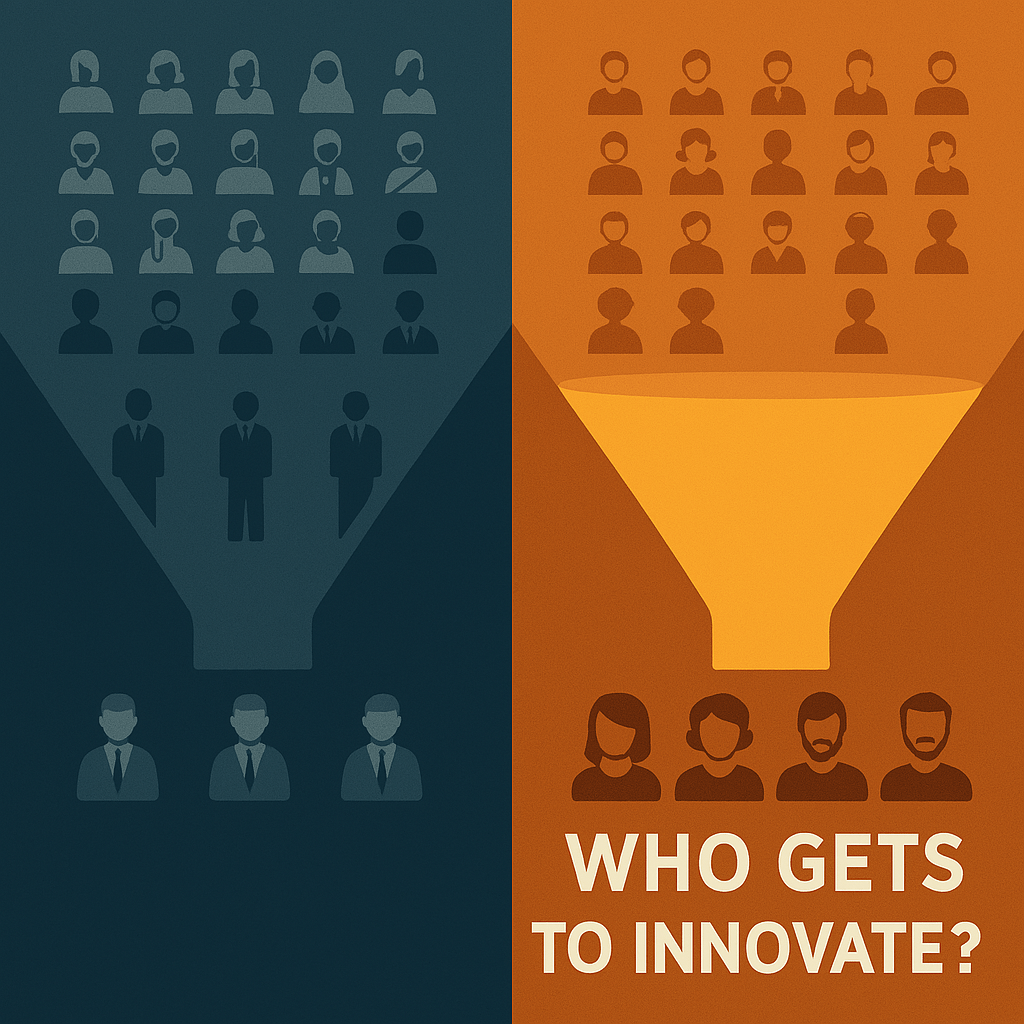
Emerging research reveals a fundamental truth: who innovates shapes what gets invented. The direction of innovation is not neutral. It is deeply shaped by lived experience — by gender, race, class, migration history, geography, sexual identity, and more. When only a narrow slice of society is represented among inventors, leaders, and researchers, entire categories of needs and ideas go unnoticed. This lack of diversity leads to gaps in innovation. Many valuable perspectives and solutions are left unexplored.
This is not just a moral argument. It’s a practical one. Excluding people from innovation doesn’t just limit their potential — it holds all of society back.
Who Becomes an Innovator — and Why Most Don’t
Research by Bell, Chetty, Jaravel, Petkova, and Van Reenen (2019) found that children from high-income families are vastly more likely to become inventors than those from less wealthy backgrounds — even when they have the same math test scores. Why? Exposure. Connections. Role models. Systems of support.
“There are many ‘Lost Einsteins’—people who would have had highly impactful innovations had they been exposed to innovation during childhood.” (Bell et al., 2019)
These insights led economist Xavier Jaravel to call for a democratization of innovation — where more people from more backgrounds have the opportunity to turn their insights into impact (Jaravel, 2025).
This isn’t only about income. It’s also about gender, race, and identity.
Agarwal, Ganguli, Gaule, and Smith (2023) found that gender parity in innovation would substantially increase scientific productivity. And yet, many LGBTQ+ individuals, immigrants, people of color, neurodiverse people, and those living in rural or disadvantaged regions are still systemically underrepresented in innovation ecosystems.
As Einiö, Feng, and Jaravel (2023) argue, “social push” plays a huge role — innovators are disproportionately motivated to solve problems they understand personally. If innovation is dominated by only a few social groups, its direction becomes narrow, its benefits uneven.
In short: when we don’t include everyone, we all lose.
A Familiar Story: The Dishwasher and Innovation Rooted in Lived Experience
One compelling example: the modern dishwasher was invented in 1886 by Josephine Cochrane, a wealthy American woman frustrated by her china getting chipped during hand-washing. While some stories suggest her servants were to blame, the more important point is this: no one had considered dishwashing important enough to automate until Cochrane experienced the problem firsthand.
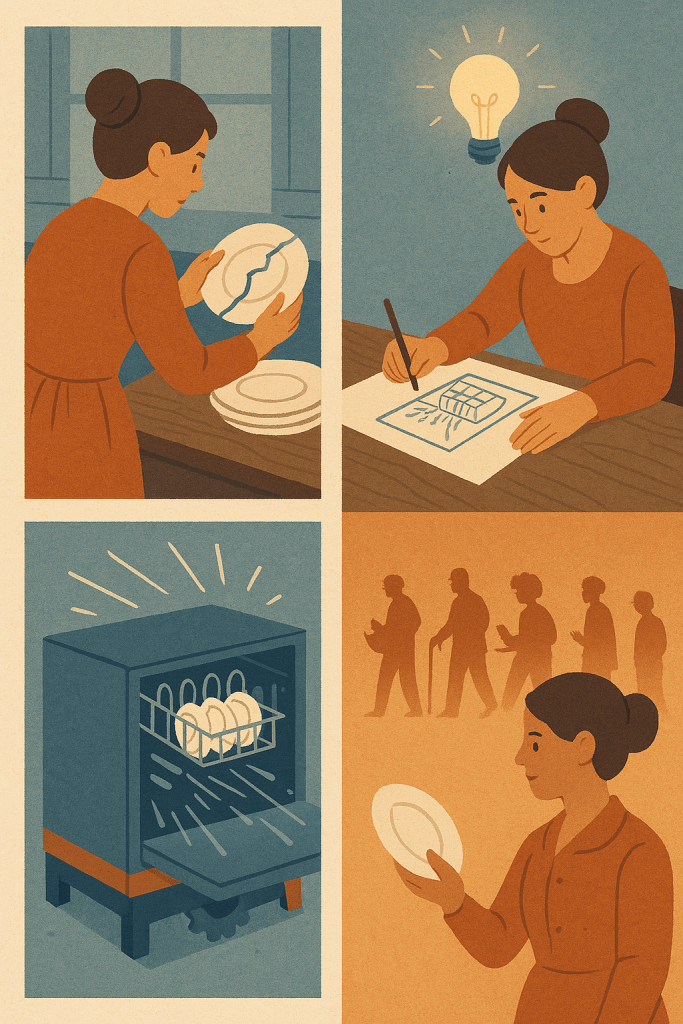
This case isn’t about privilege — it’s about perspective.
And it mirrors what many modern studies are saying: when innovators come from a broader range of experiences, they create new kinds of value.
What if their ideas had the same support as those from elite institutions or corporate labs?
Haus Europa: A Platform for Belonging, Imagination, and Breakthroughs
Haus Europa is based in Tux, Austria. It is a nonprofit association in the making. The organization believes the future of innovation lies in inclusion.
We’re creating a space and a method for people from all walks of life — across gender, generation, race, identity, profession, and origin — to come together and imagine a better Europe. A better world. Through interdisciplinary labs, leadership residencies, and collaborative programs, Haus Europa plans to offer the conditions for breakthrough thinking grounded in purpose, trust, and belonging.
The vision of Haus Europa is to support:
- People with ideas but no access to traditional innovation networks,
- Underrepresented voices ready to shape the future of leadership, culture, technology, and community,
- Collaborations between thinkers, doers, creatives, and policymakers across Europe and beyond.
All of this happens in the inspiring alpine environment of Tux — a place for clarity, reconnection, and creative courage.
What the Research Demands — and What Haus Europa Will Offer
Research from the Peterson Institute (Noland et al., 2016) has shown that companies with more gender-diverse leadership are more profitable. But the study also makes a deeper point:
“The direction of innovation can be influenced by the background of innovators” — and when those backgrounds are too similar, the innovations are too narrow.
(Noland, Moran, & Kotschwar, 2016, p. 47)
Haus Europa wants to contribute to the change of that direction.
By expanding who gets to join in innovation, we expand what’s possible.
In Haus Europa, we believe that everyone has a role in shaping future — not just the usual suspects.
Not just in cities. Not just in boardrooms.
But also in mountains, villages, and communities often overlooked.
Because when innovation begins with inclusion, the future becomes truly shared.
Miroslav Hazer,Co-Founder
References:
Agarwal, R., Ganguli, I., Gaule, P., & Smith, G. (2023). Why US Immigration Matters for the Global Advancement of Science. Research Policy, 52(1), 104659. https://www.sciencedirect.com/science/article/pii/S0048733322001809
Bell, A. M., Chetty, R., Jaravel, X., Petkova, N., & Van Reenen, J. (2019). Who Becomes an Inventor in America? The Importance of Exposure to Innovation. Quarterly Journal of Economics, 134(2), 647–713. https://opportunityinsights.org/paper/losteinsteins/
Einiö, E., Feng, J., & Jaravel, X. (2023). Social Push and the Direction of Innovation. VATT Working Paper No. 160. https://ideas.repec.org/p/fer/wpaper/160.html
Jaravel, X. (2025, March). Innovation’s Unseen Frontier. Finance & Development. International Monetary Fund. https://www.imf.org/en/Publications/fandd/issues/2025/03/innovations-unseen-frontier-xavier-jaravel
Noland, M., Moran, T., & Kotschwar, B. (2016). Is Gender Diversity Profitable? Evidence from a Global Survey. Peterson Institute for International Economics. https://www.piie.com/publications/working-papers/gender-diversity-profitable-evidence-global-survey
Photo credit: the featured photo by Jakub Nedbal
Illustrations: ChatGPT




 Haus Europa